
Exit the Cave
Ain’t it fun, livin’ in the real world?

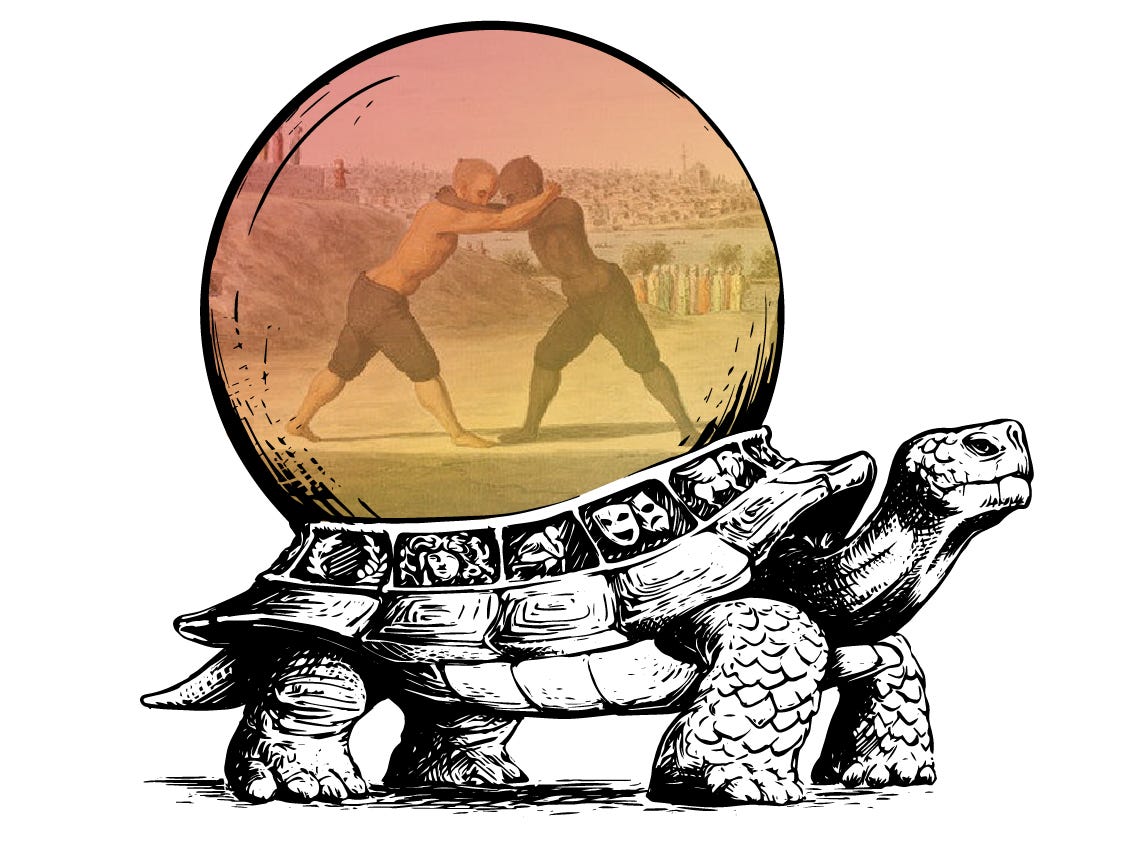
There’s something romantic about the Cave. About grinding away at something in private. About training with headphones on in our own little world. About stepping away for six months to emerge “unrecognizable” to all those people we imagine thinking about us.
This masculine urge to “grind” seems to be gaining popularity. It reminds me of an incredible Under Armour ad for Michael Phelps’s iconic return to the 2016 Olympics which ended with the quote: “It’s what you do in the dark that puts you in the light.”
Yet the Cave, despite its darkness of solitude and dampness from sweat and suffer-porn, is comfortable. It lets us tinker with our own delusions. If we spend too much time in the Cave, our pupils dilate, and our assumptions start to look like reality. That somehow this training regimen will unlock athletic prowess, or that our perfectly polished product will be loved by millions of users around the globe. I find Paramore playing in my head.
“See, it’s easy to ignore trouble, when you’re living in a bubble.”
Culture has created a cozy Cave. Smart devices reward private fitness. Recommendation algorithms propagate our preexisting philosophy through personalized programming. AI tells us what we want to hear and bolsters our assumptions instead of challenging them. We grow so comfortable curating our Cave that we forget the vast, interesting, beautiful, and brutal world beyond its walls.
I say all this because I’ve spent years mistaking effort for progress. I learned this lesson nearly twenty years ago on a wrestling mat.
“So, what are you gonna do, when the world don’t orbit around you?”
As the cold winds off Lake Michigan blew snow over Kenowa Hills High School, two dozen young men grappled in a sweaty, windowless room. For four winters, I wrestled. I’d start the season in November, feeling strong and fit. Five months later, after hundreds of hours training in sweatsuits on an empty stomach and a dozen Saturdays spent in gyms across West Michigan, I’d enter April pale, malnourished, and occasionally plagued by a skin disease like impetigo. At one point, I cut seven pounds a week to make the 119-pound weight class. Despite all that, I loved wrestling more than any other sport and miss it dearly.
Not because I was good. In fact, I was terrible. I got pinned more often than I pinned and lost more often than I won. But those few times my arm was raised were sweeter than almost anything. There is something undeniably beautiful in wrestling’s brutality.
There’s no gear to give an advantage—no special cleats, rackets, or pads. There are no conditions to create excuses—no weather, no nets, no sun in the eyes. And there’s nothing to hide behind. Just you and your opponent for six minutes of utter exhaustion. When you win, you win. When you lose, you lose. Because we cannot guarantee that outcome, we obsess over the inputs.
“Don’t go cryin’ to your mama, ‘cause you’re on your own in the real world.”
When we want something, we often want our concept of how to achieve it to be true. Sure, I wanted to pin my opponent on the mat. But I also wanted my approach to yield success. Freshman year, I figured my biggest gap was technique—once I learned the right movements, I would win. Sophomore year, I figured my biggest gap was conditioning. If I pushed myself hard, running stairs faster and doing more pushups than my teammates, I would win.
Yet year after year, when I stepped onto the mat, I didn’t qualify for regional or state tournaments. I didn’t secure the championships I imagined. The mat was the cold, unrelenting reality that all my toiling in the Cave had failed to overcome. Technique mattered. Conditioning mattered. But I had made the comfortable mistake of believing that because I could measure and control them, they must determine the outcome.
Dan Gable, Olympic gold medalist, legendary Iowa coach, and one of the greatest wrestlers of all time, summed up wrestling like this: “The first period is won by the guy with the best technique, the second period is won by the guy with the best conditioning, and the third period is won by the guy with the biggest heart.”
This is not a pithy oversimplification. The desire to win is simple but not obvious. Sure, I thought I wanted to win. But really, I wanted my team to not lose. That might sound noble and unselfish, but it was far from it. Yes, I cared about my team, but my motivations weren’t noble. I didn’t want to miss weight and disappoint them because I would then feel shame. I was avoiding negative feelings, not seeking victory. The mat had exposed a more uncomfortable truth than my lack of talent: I did not want what I thought I wanted.
Ironically, this misplaced desire ended up hurting my team. I showed up, trained hard, and made weight, but when I didn’t subdue my opponent, it cost us points. I had to want victory enough to let reality teach me what it required. Truly pursuing victory would benefit the team far more than grinding away in the Cave. I needed to stop wrestling not to lose and learn to wrestle to win.
I’m not here to self-flagellate. I say all this to remember a truth I’ve let gather dust. There is a kind of cowardice that looks a lot like discipline. A writer needs readers. An entrepreneur needs customers. An athlete needs competition. A lover needs someone free to reject him. Any worthy pursuit needs a mat.
“Ain’t it fun, livin’ in the real world?”
Better to be pinned in public with courage than to train endlessly in private like a coward. Ship that product, share that story, step into the ring, take the risk of love. Even if you end up on your back, you did it in the real world.